
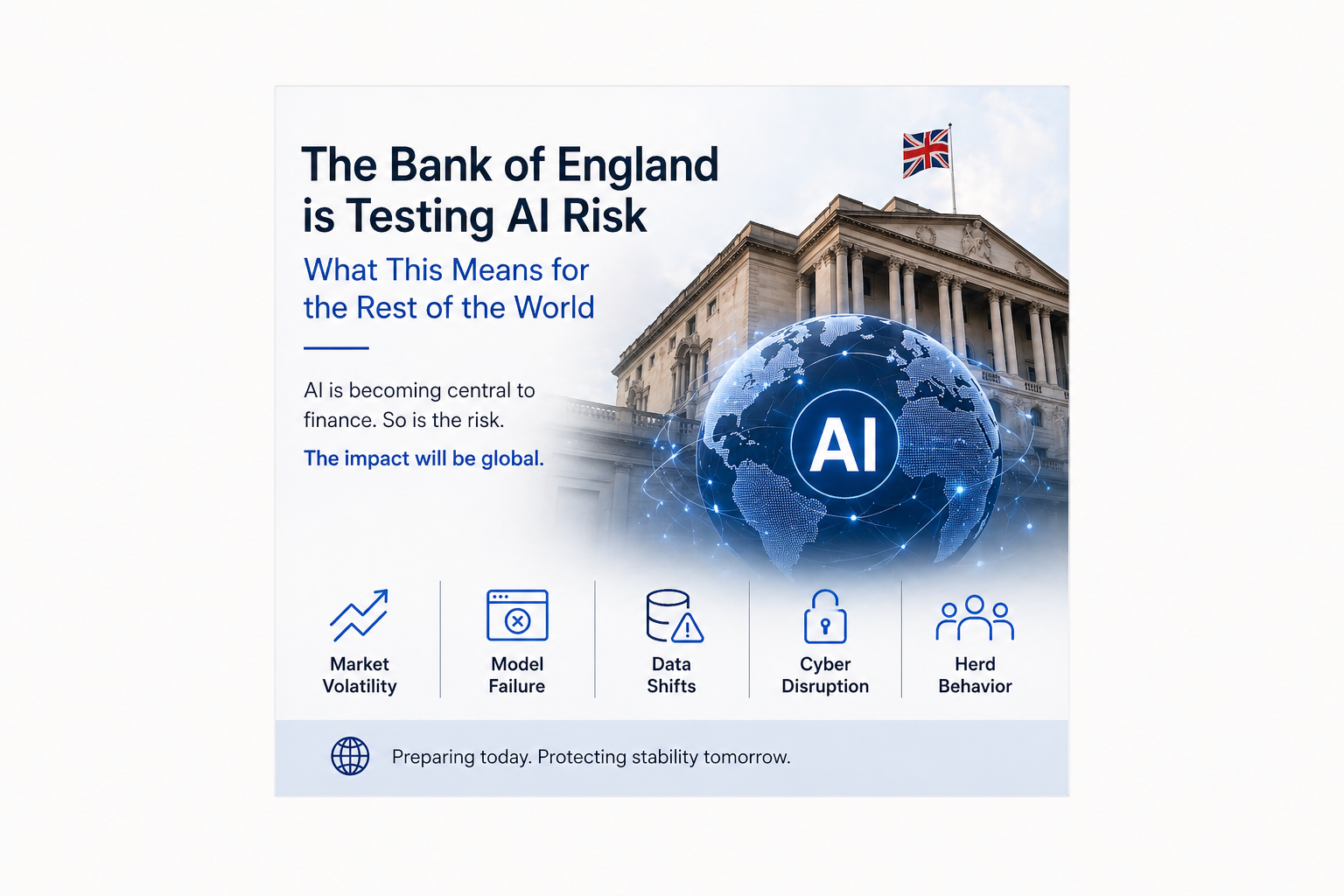
When financial regulators begin stress-testing a technology, they are sending a signal of preparedness.
That is precisely what happened when the Bank of England announced that it was running scenario simulations to assess how artificial intelligence could affect financial stability. The exercise examines a simple but consequential question:
What happens when many institutions rely on the same AI systems at the same time?
This is not a theoretical concern; it reflects a structural shift. AI is evolving from a firm-level tool into shared infrastructure that shapes market behavior. As its adoption scales, its effects are no longer isolated to individual institutions but become embedded in the dynamics of the financial system itself.
Financial regulators have long used stress testing to assess how shocks ripple through interconnected institutions. By simulating extreme but plausible scenarios, such as abrupt market corrections, liquidity constraints, or correlated institutional failures. These exercises evaluate the resilience of the system as a whole, not just its individual components.
AI systems are now entering a comparable domain of regulatory attention. The core risk is not malfunction, but convergence. Where multiple institutions deploy similar models trained on overlapping data and optimized for similar objectives, outcomes may align in ways that amplify systemic vulnerability. Under such conditions, decision-making can become synchronized, risk signals may transmit rapidly across institutions, and market volatility can be exacerbated.

Coordination — even unintended — can become systemic risk.
This is why the Bank of England’s move matters. It reflects a shift in how regulators are beginning to perceive AI, as infrastructure that could influence the behavior of entire systems.
Is the Rest of the World Doing the Same?
Not yet, but the direction is clear.
Across Africa, the Middle East, and Asia, regulators are starting to scrutinize AI and algorithmic risk, though frequently through different lenses, framing it as digital risk, model risk, or fintech oversight. The underlying logic is the same:
understand the risk before dependence becomes vulnerability.
Africa: Building the Foundations
In many African countries, regulators are still focused on strengthening digital financial systems and expanding financial inclusion. As a result, risk supervision tends to center on fintech stability, cybersecurity, and operational resilience rather than formal AI stress testing. Several African regulators have established financial regulatory sandboxes to help regulators understand emerging technologies while monitoring and containing risks. The Bank of Ghana launched a regulatory sandbox in 2023 for testing innovative financial products and services in a controlled environment. Kenya, Namibia, Rwanda, Tanzania, Zambia, and Mozambique have all launched sandbox initiatives to promote innovation and foster regulatory agility. These efforts represent an important first stage for regulators, ensuring that digital systems themselves are stable and well governed. Sandbox initiatives across Africa are creating a structured, enabling environment where financial service providers can test new products, services, and business models with regulatory oversight. Building on this foundation, there is a clear opportunity to broaden the scope of these sandboxes to encompass operational innovation, including the integration of AI within the financial sector.
The Middle East: Rapid Adoption, Emerging Oversight
Several Gulf states are moving swiftly toward structured AI risk governance, propelled by substantial investment in digital infrastructure and state-led innovation agendas. The Central Bank of the UAE issued guidance in February 2026 on the responsible use of AI and machine learning in financial services, addressing governance, fairness, transparency, human oversight, and data privacy. Bahrain’s Central Bank, widely regarded as a regional pioneer, has operated a long-running sandbox model that has set the tone for fintech innovation testing across the Gulf.
Saudi Arabia has built one of the region’s more structured approaches. The Saudi Central Bank (SAMA) runs a regulatory sandbox that operates as a staged, regulator-in-the-room testing environment, imposing limits on scale, customer exposure, and risk — with full authorisation granted only once safety is demonstrated. SAMA continues to admit new fintechs, including several in early 2025, reflecting active management of AI-linked innovation rather than passive oversight. More broadly, Saudi Arabia is developing supervisory frameworks for AI-enabled financial services, with an emphasis on preparedness and cross-border regulatory cooperation. Qatar Central Bank rounds out the picture, having issued an AI guideline in 2024 for licensed entities focused on safe, efficient, and transparent deployment. Across these frameworks, scenario-based risk assessment is emerging as a common feature.
Asia: Closest to Formal AI Stress Testing
In Asia, some regulators are already approaching the level of institutional maturity reflected in the Bank of England’s initiative. The Monetary Authority of Singapore has issued detailed guidance on AI risk management and model governance, encouraging financial institutions to test algorithmic systems under adverse conditions. Similarly, regulators in India and China are tightening oversight of automated lending and digital financial platforms due to concerns about consumer harm, systemic risk, and financial stability. In India, the Reserve Bank has issued digital lending rules and is tightening oversight of app-based and cross-border lending platforms because of consumer protection and stability risks. China’s regulatory shifts have centered on bringing internet platforms and fintech firms under tighter financial supervision. These efforts demonstrate a growing recognition that AI risk is not merely technical.
Why This Matters
The need for AI stress testing is evoked by dependence. As AI becomes embedded in banking and payments, insurance and credit scoring, public service delivery, energy and telecommunications, and transportation and logistics, the potential for coordinated disruption increases. This is particularly relevant in economies where shared vendors, centralized platforms, and rapid digital adoption can amplify systemic risk. In such environments, a single widely used algorithm can influence thousands or millions of decisions simultaneously.
The Next Phase of AI Governance
The Bank of England’s decision to test AI risk is an early indicator of a broader transition in regulatory practice. We are entering a phase where governments will begin to treat AI the way they treat other critical systems:
- as a source of systemic risk
- as infrastructure
- as an object of continuous oversight
Stress testing will become a routine part of managing that risk.
What Should Policymakers and Institutions Do Now?
The lesson from the Bank of England is not to wait for failure. It is to prepare for dependence. For regulators and institutions, the next steps are clear:
- Map where AI systems are already embedded
- Identify shared models and vendors
- Develop scenario-based risk testing
- Build institutional capacity for continuous oversight
The Signal to Watch
Stress testing is the beginning of institutional maturity. When regulators begin testing a technology, they are acknowledging that it matters to stability. The Bank of England has taken that step. The rest of the world will follow; the question is how soon and how rigorously?