
Article
-
How Organizations Move from Competing Stakeholder Perspectives to Evidence-Based AI Deployment Decisions

When governance begins with structured risk assessment rather than assumptions, organizations are able to translate stakeholder perspectives into measurable risks, document them in a Risk Register, and evaluate readiness through a Readiness Matrix. This approach enables organizations to create transparent, repeatable governance processes that enable responsible AI adoption.
-
Disclosure Is Not Accountability: New York’s AI Court Rule and the Future of Legal Responsibility

Can simply disclosing AI use satisfy legal responsibility? As courts embrace artificial intelligence, the real challenge is no longer transparency, but ensuring meaningful accountability when technology influences justice.
-
AI Agents and the Rule of Law: Can Existing Safeguards Govern Machine Agency?

AI agents are no longer just assisting lawyers. They are making decisions. Can existing legal safeguards govern machines acting with increasing autonomy before accountability begins to disappear?
-
Getting Ahead of AI Copyright: A Governance Roadmap for Organizations

The greatest AI copyright risk is not tomorrow’s lawsuit but today’s governance gap. Is your organisation prepared before legal uncertainty becomes institutional liability?
-
How Do We Know if an AI System Is Safe, Fair, Reliable, and Trustworthy?

One of the most consequential questions in technology governance today is also one of the most underexamined: how do we establish, and sustain, meaningful trust in automated decision-making systems, particularly when those systems affect the most fundamental aspects of people’s lives? In other words, how do we know if an AI System Is safe, fair,…
-
Why High-Risk AI in Employment Demands More Than Ethics Statements
Artificial intelligence is no longer sitting at the edges of human resources as an experimental productivity tool. It is increasingly being used to influence who gets hired, who gets promoted, who is flagged as a performance concern, and in some cases, who is pushed out of the workforce. That reality is forcing regulators around the…
-
From Stress Tests to Global Standards: How the Bank of England Is Shaping AI Risk Oversight Worldwide
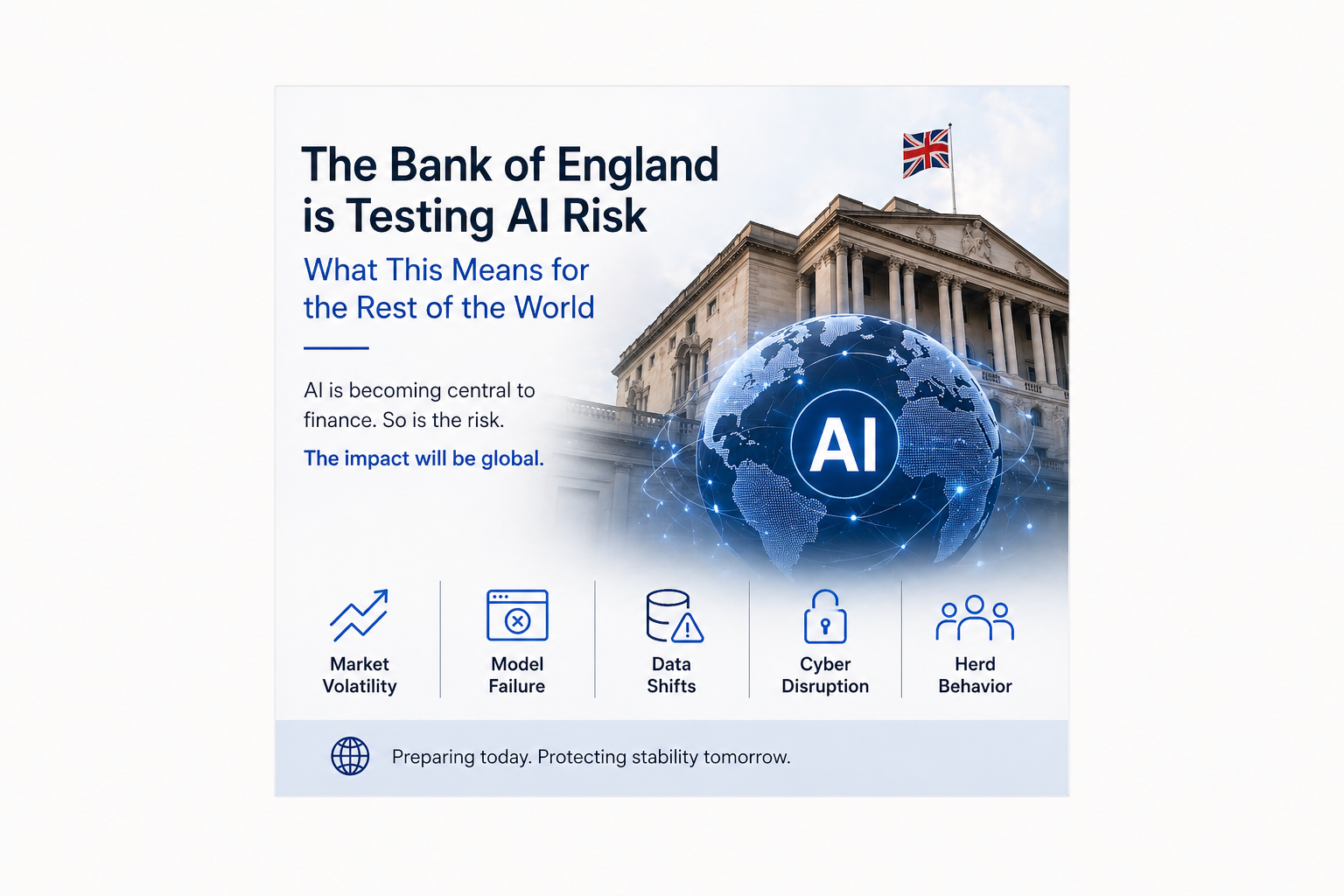
When financial regulators begin stress-testing a technology, they are sending a signal of preparedness. That is precisely what happened when the Bank of England announced that it was running scenario simulations to assess how artificial intelligence could affect financial stability. The exercise examines a simple but consequential question: What happens when many institutions rely on…
-
From Harm to Accountability: What Recent Global Litigation Reveals about Digital Safety Enforcement

Why documented harm alone does not produce accountability, and what institutions must build to translate incidents into protection for children online. Design Is Global. Liability Is Evidentiary. Social media platforms operate on largely uniform technical architectures across the world. Features such as infinite scrolling, algorithmic recommendations, and autoplay video are not localized technologies; they are…
-
The Illusion of Safe EdTech: PowerSchool and the Global Risks to Student Data

As AI‑enabled tools are woven into educational systems in Africa and the broader Global South, they are plugging into environments where data protection laws may be nascent or weakly enforced, procurement rarely interrogates security design, and institutions have limited capacity to audit vendors’ technical claims. The potential harm is not hypothetical: once student data is…
-
From Storms to Signals: Co-Designing AI-Powered Maritime Safety with Ghana’s Fishermen

In many coastal communities, small-scale fishing fleets operate outside major shipping and offshore networks. The Center for Law and Innovation Policy (CLIP) and the Institute for AI Policy and Governance (AIPG) have spent recent weeks in conversations with artisanal fishermen in Jamestown and Chorkor, not to pitch solutions, but to listen and gather insights for…